
 العربية
 Русский
 اردو
اردو
 中文
中文
 Français
Legal Services for Diplomatic Missions and Business Communities
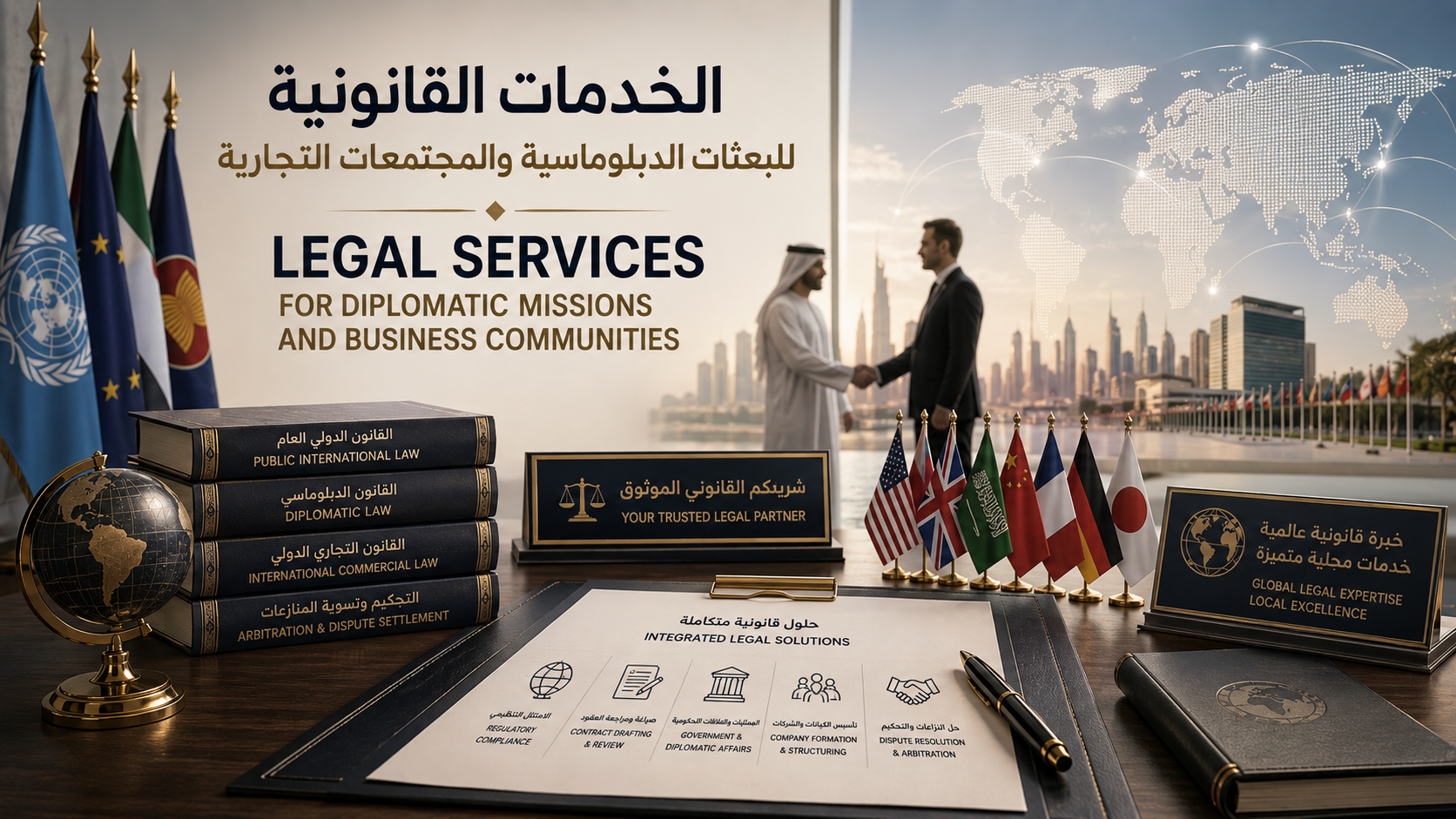
Diplomatic and consular missions, business councils and foreign chambers of commerce operating in the United Arab Emirates require specialised legal representation that combines a command of the international law rules governing diplomatic and consular relations with practical experience of the federal and local legislation in force within the State. Such representation covers the drafting and review of contracts, the handling of employment matters relating to staff engaged by missions, the arrangement of lease and service agreements, and representation before the courts and official authorities within the limits permitted by law, alongside ongoing advice to business councils on their establishment, governance and activities. In this article, AWADH ALMHEIRI LAW FIRM AND LEGAL CONSULTATIONS sets out the legal framework governing these services, the scope of jurisdictional immunity and the exceptions to it, and the principal legal needs of business communities and expatriate communities in the State.

Who are these legal services intended for?
The entities benefiting from these services fall into three main categories that differ in legal nature and in the privileges they enjoy. That difference results in a clear variation in the legal approach applicable to each category:
Embassies accredited to the State together with their diplomatic agents and administrative and technical staff. Their relationship with the receiving State is governed by the Vienna Convention on Diplomatic Relations.
Consulates-general, consulates, vice-consulates and consular officers, governed by the Vienna Convention on Consular Relations, where the scope of immunity is narrower than its diplomatic counterpart.
Foreign business councils, joint chambers of commerce, business groupings and expatriate communities. These entities enjoy no diplomatic immunity and are fully subject to the legislation in force in the State.
This distinction is above all a practical one: a legal step that may validly be taken against a business council or a commercial entity belonging to a community may not be available against a diplomatic mission, and the converse applies with regard to advisory and contractual services.
The legal framework governing missions in the State
The work of diplomatic and consular missions in the United Arab Emirates rests on two complementary sources: the rules of international law set out in the Vienna Convention on Diplomatic Relations and the Vienna Convention on Consular Relations, and the national legislation in force in the State. The Vienna Convention on Diplomatic Relations affirmed the inviolability of the premises of the mission, its correspondence and its archives, while at the same time imposing a corresponding duty requiring all persons enjoying privileges and immunities to respect the laws and regulations of the receiving State and not to interfere in its internal affairs.
Jurisdictional immunity: its scope and the exceptions to it
The Vienna Convention on Diplomatic Relations provides that a diplomatic agent enjoys immunity from the criminal jurisdiction of the receiving State, together with immunity from its civil and administrative jurisdiction. It nevertheless sets out specific exceptions to civil and administrative immunity, the most prominent of which are:
The Convention further permits the sending State to waive the jurisdictional immunity of its agent, requires that the waiver be express, and requires a separate waiver in respect of the execution of the judgment, so that waiver of immunity from suit does not of itself imply waiver of immunity from execution. In the consular sphere, the Vienna Convention on Consular Relations confines immunity in principle to acts performed in the exercise of consular functions, subject to exceptions including civil actions arising from a contract not concluded by the consular officer as an agent of the sending State, and actions brought by a third party for damage arising from an accident caused by a vehicle, vessel or aircraft within the receiving State.
Legal services required by diplomatic and consular missions
| Area of service | Scope of legal work |
| Contracts and agreements | Drafting and review of service, supply, maintenance and insurance contracts, and regulation of termination clauses and dispute settlement. |
| Property and leases | Premises of the mission and residences of its members, documentation and registration of leases, and handling of tenancy disputes. |
| Staff matters | Regulation of contracts for locally engaged staff, internal work regulations, and the handling of employment claims. |
| Notarisation and attestation | Preparation of powers of attorney and instruments, their attestation, and fulfilment of the requirements of official authorities in the State. |
| Representation and follow-up | Representation before courts and competent authorities within the limits permitted by law, and follow-up of official files. |
| Protecting the interests of nationals | Advising the mission on the legal position of its nationals and coordinating the follow-up of their cases. |
Business councils and business communities: establishment and governance
Foreign business councils and joint chambers of commerce are among the most important instruments for organising the relationship between expatriate business communities and the Emirati market. They are entities subject to licensing and supervision by the competent authorities in the State and enjoy no jurisdictional immunity, so the stability of their legal position depends on the precision of their constitutive documents and the clarity of their internal governance.
Employment disputes within missions and business councils
Employment relations represent the field that gives rise to the greatest practical difficulty in files of this kind, since missions and business councils engage local and expatriate staff whose relationship is governed by employment contracts, while the nature of the employer varies between an entity fully subject to national legislation and a mission enjoying procedural immunity. Sound legal handling therefore begins at the drafting stage rather than at the dispute stage: a well-constructed contract that defines the nature and duration of the relationship, the wage and its components, the mechanism of termination and the means of settling disagreement reduces the likelihood of a dispute to a minimum.
The lawyer's role here consists of correctly characterising the relationship, identifying the authority competent to hear the claim, determining whether immunity bars the bringing of proceedings, and then selecting the most appropriate course among amicable settlement, official channels and litigation, in a manner that preserves the rights of both parties and safeguards the relationship between the receiving State and the mission.
Representing communities and foreign nationals in coordination with their missions
Among the core functions of a consular post under the Vienna Convention on Consular Relations is protecting the interests of the sending State and of its nationals, both individuals and bodies corporate, within the limits permitted by international law, and rendering assistance to them. It follows that many embassies and consulates require a licensed Emirati law firm to which they may refer their nationals' cases or from which they may seek advice, whether in civil and commercial disputes, employment matters or criminal cases.
AWADH ALMHEIRI LAW FIRM AND LEGAL CONSULTATIONS provides this service within a disciplined professional framework that preserves the confidentiality of information and explains to the mission and to the client alike the client's legal position, the options available and the consequences of each option, without promising outcomes that no one is able to guarantee.
Why must you deal with a registered Emirati advocate?
The Federal Decree-Law regulating the professions of advocacy and legal consultancy governs the conditions for practising the profession in the State and restricts rights of audience and appearance before the courts to persons who satisfy the conditions prescribed by law and are entered on the roll of advocates. Accordingly, legal advice alone does not suffice for a mission or a business council once a file reaches the litigation stage; at that point an Emirati advocate is required who holds rights of audience before all degrees of litigation, including the Federal Supreme Court and the Court of Cassation.
Practical guidance for missions and business councils
Legal references
Frequently asked questions