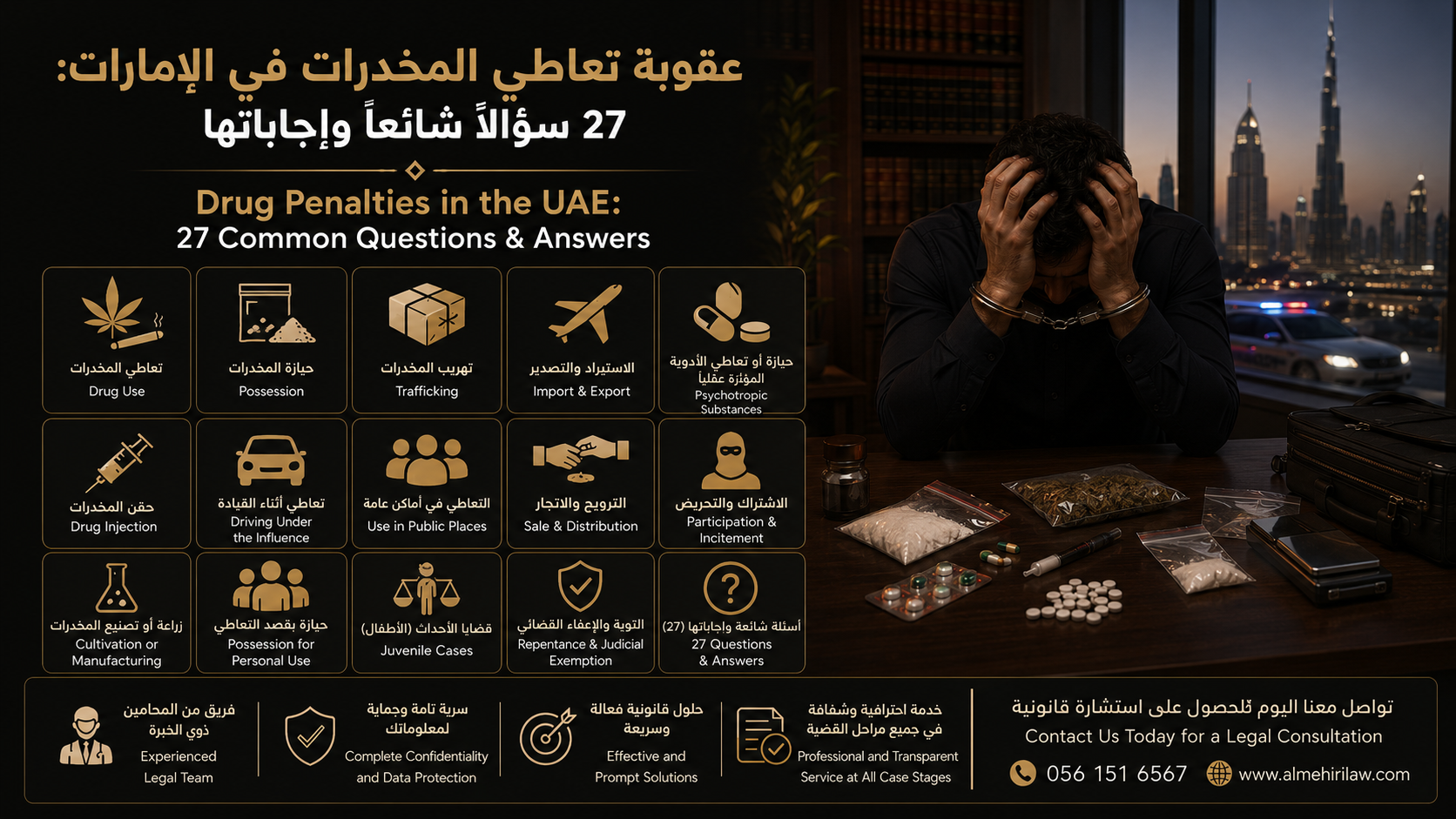
These are the questions our firm receives most often in cases involving narcotic drugs and psychotropic substances, arranged by their place in the course of a case: from the moment of testing, to a request for treatment, to possession and importation, to what follows judgment. The answers are drawn from the text of the law in force on combating narcotic drugs and psychotropic substances and its amendments, not from general estimates. The first thing to know is that the law draws a decisive distinction between a person who is apprehended and a person who comes forward requesting treatment before an arrest order is issued — and that no criminal case is brought against the latter at all. Beneath each answer lies the detail that determines the outcome in practice, because a single fact can change the legal characterisation entirely.

I. Questions on Testing and Personal Use
These are the most frequent questions, and the most closely tied to the moment of apprehension:
QMy test came back positive — what is the penalty?
It varies according to the type of substance and the number of occasions. For substances listed in Tables 1, 2 and 5, the penalty on the first occasion is detention of not less than 3 months or a fine of 20,000 to 100,000 dirhams. On a second occasion within 3 years it rises to detention of at least 6 months or a fine of 30,000 to 100,000 dirhams. On a third or subsequent occasion it becomes detention of at least two years and a fine of no less than 100,000 dirhams.
QIs the penalty for a first offence different from a second or third?
Yes, and the difference is fundamental. The law builds an ascending scale on the number of occasions, and ties the aggravation of the second occasion to its occurring within 3 years of the date of the first act. More importantly, the court retains the power to go below the prescribed penalty on the first and second occasions, while this is barred in other situations, and suspension of enforcement is not permitted on a third or subsequent occasion.
QThe Public Prosecution asked for a test sample — can I refuse?
Refusal is a separate offence, in many cases graver than personal use itself. A person against whom an order has been issued by the Public Prosecution to take a test sample, and who refuses without justification, is punished by detention of not less than two years and a fine of not less than 100,000 dirhams. In other words, refusal may expose you to a heavier penalty than the one you were trying to avoid.
QThe quantity was small and mixed with other matter — does that reduce the weight?
No. The law expressly provides that the degree of purity of the substance is not taken into account in determining its weight once its presence is established by the forensic report, and that the components and impurities mixed with it form an indivisible part of the total weight. Where the substance takes a pharmaceutical form, reliance is placed on the proportion by weight of the substance within that form as stated on the manufacturer’s packaging.
QI was present where others were using but I did not use — am I liable?
Yes, if you knew the nature of the place. A person apprehended in a place prepared for the use of narcotic substances, knowing its nature, is punished by detention of 6 months to one year and a fine of 10,000 to 20,000 dirhams. The law exempts from this the spouse, ascendants and descendants of the person who managed, prepared or arranged the place.
II. Questions on Treatment and Exemption From Prosecution
This is the chapter most people are unaware of, and it is the most consequential in practice:
QIf I turn myself in and ask for treatment, will a case be brought against me?
No. The law provides that no criminal case shall be brought against a user who comes forward of his own accord to the treatment unit, the Public Prosecution or the police before an order for his arrest is issued, requesting to be placed for treatment; he is then placed with the unit until it decides on his release. The decisive condition here is timing: before the arrest order.
QCan my family request that I be placed in treatment?
Yes. The law permits the request to be made by the spouse, a relative up to the second degree, a person responsible for his upbringing, or the educational institution at which he studies, after coordination with the child protection specialist and with the consent of his parents. Where the request comes from anyone else, the placing entity must obtain the consent of the Public Prosecution on placement or release.
QI have substances on me and want to request treatment — does the exemption apply?
It applies on condition of surrender. The law expressly excludes from the exemption any person who was in possession of a narcotic drug or psychotropic substance and did not hand it over to the unit, the Public Prosecution or the police when coming forward to request treatment, as well as any person who refused a placement ordered by the Public Prosecution. In those two cases the criminal case takes its ordinary course.
QHow long does treatment in a rehabilitation unit last?
The period of treatment and rehabilitation may not exceed one year in any case. After hearing the opinion of the Public Prosecution, the court may order the release of the person placed if the report shows that his health condition permits it, or upon his own application with the approval of the supervising committee.
QCan the court order treatment instead of detention?
Yes, other than in cases of recidivism. The law permits the court to substitute for the penalty the placement of the convicted person in a treatment and rehabilitation unit, after hearing the opinion of the supervising committee, which must submit a report on his condition within 6 months. A person previously placed in the unit under an earlier judgment, or who left it less than 3 years ago, may not be placed there.
QWhat happens if I do not comply with the treatment plan?
The unit notifies the Public Prosecution, and the supervising committee prepares a report on the breaches, which is submitted to the competent prosecution. In that case the court orders detention of not less than one year, with the period of placement deducted from the period adjudged. The law also provides that no criminal case is brought against a person who completes the treatment programme.
III. Questions on Possession, Importation and Trafficking
Here the characterisation shifts from misdemeanour to felony by reason of intent, not quantity alone:
QWhat is the difference between use, possession and trafficking?
The difference lies in intent. Possession for personal use falls under the provisions on use, punishable by detention or a fine. Possession or custody with intent to traffic or promote, by contrast, is punishable by imprisonment, and in breaches of the provisions on importation, bringing in and cultivation it reaches the death penalty where committed with intent to traffic or promote, or where the offender belongs to a hostile group or an organised gang.
QA friend put something in my pocket without my knowledge — where do I stand?
The law punishes the person who did that to you, not the reverse. Whoever deliberately transfers narcotic drugs or psychotropic substances into the possession or custody of another without that person’s knowledge of their true nature is punished by imprisonment. Your own position turns on establishing the absence of knowledge, which is built on the details of the incident, the available evidence and the records of apprehension.
QSomeone spiked my drink or food — what is the penalty for that?
Imprisonment for a term not exceeding 5 years and a fine of not less than 20,000 dirhams. It rises to imprisonment of not less than 10 years where the act was committed with intent to commit an offence against the victim or to make him an addict — and the materialisation of that result is an aggravating circumstance. The penalty is life imprisonment or death where the act results in the victim’s death.
QI wore clothing bearing a prohibited plant design — is that an offence?
Yes, and this is a provision many are unaware of. Whoever manufactures, imports, brings in, sells or possesses with intent to promote any goods or printed matter bearing images, drawings or writings calling for or inciting drug offences is punished by a fine of not less than 50,000 dirhams. Whoever wears any such clothing or uses any such item is punished by a fine of not less than 5,000 dirhams, and on repetition by detention not exceeding two years.
QWhich court hears the case?
For offences of use and personal consumption, jurisdiction lies with the court within whose territorial area the user was apprehended. Offences committed with intent to traffic or promote, offences connected with them indivisibly, and facilitation offences fall within the exclusive jurisdiction of the federal courts sitting at the seat of the federal capital.
IV. Questions From Travellers and at Border Points
Questions from those arriving in the State form a large share of what we receive, and they are governed by special provisions most travellers do not know:
QI have medication prescribed by a doctor abroad — does it count as narcotics?
Use or personal consumption is permitted only for treatment and under a medical prescription issued by the treating physician in accordance with the controls laid down in the law. As for prescriptions issued abroad for narcotic and psychotropic medicines, the law refers the regulation of their controls and the procedures for bringing them into the State to a decision of the Cabinet. The matter is therefore primarily regulatory, and those procedures must be completed before travelling.
QI brought in food or a product containing a prohibited substance — what is the position?
There is an express exception. It does not constitute punishable bringing in, importation, transport or possession where a person arriving from abroad carries food, drink or products containing certain substances specified in particular items of the Schedules, for the purpose of personal use, on first apprehension at the State’s approved entry points. An administrative record is drawn up and the products are seized and destroyed.
QI am a visitor and something was found on me on entry — will I be imprisoned?
The law lays down a special rule for non-citizens and those not lawfully resident in the State who are apprehended while entering through any land, sea or air point in possession or custody of a narcotic drug or psychotropic substance for personal use: the penalty is a fine of 5,000 to 1,000,000 dirhams. A Cabinet decision regulates the amount according to the type and weight of the substance and the number of apprehensions, and the cases in which the offender is barred from entering the State and the duration of that bar.
V. Questions on Deportation and Residents
Deportation is the most pressing question for residents, and the law provides one rule and two exceptions:
QIs a foreign national deported in a drug case?
As a rule, yes. The court orders the deportation of a foreign national convicted of one of the offences provided for in the law. However, the law lays down two specific exceptions in which he is excluded from the deportation measure — two exceptions that must be invoked before the court with supporting documents.
QMy wife is a citizen — does the exception cover me?
Yes, if the condition of the text is met. The first exception covers a person who, at the time of committing the offence, was the spouse of a citizen or a relative of a citizen by blood in the first degree. This exception rests on the status at the time the act was committed, not at the time of trial — a distinction often overlooked when preparing the defence.
QI support my family living here — does that help?
It may. The second exception covers a person who is a member of a family residing in the State where the court finds that his deportation would cause serious harm to the stability of the family or deprive one of its members of necessary care or support, and where the court is satisfied that the family is financially able to provide treatment for him. Family here includes the grandfather, grandmother, father, mother, children, brothers and sisters.
VI. Questions on What Follows Judgment
The end of the penalty is not the end of its consequences, and these are the questions most often asked after judgment:
QWill the case be recorded on my criminal record certificate?
The law provides that offences of use and personal consumption are not treated as a criminal antecedent requiring rehabilitation where committed for the first time by citizens. It also provides that suspension of enforcement of the penalty may not be ordered where the offence is committed for a third or subsequent time.
QWill my driving licence be withdrawn?
A judgment in an offence of using narcotic drugs or psychotropic substances on more than one occasion entails that the convicted person shall not be licensed to drive motor vehicles, or that his licence shall be cancelled if already issued. This consequence ends upon the lapse of one year from the date of completion of enforcement of the adjudged penalty.
QHow long does periodic testing continue after the case?
The convicted person, or a person placed by order of the court, is subject to periodic testing during enforcement of the penalty or during the period of placement, and that subjection continues for a period not exceeding two years after enforcement of the penalty or the end of the placement period. Breach of the rules and procedures of periodic testing is punishable by detention of not less than one year.
QWill I be barred from transferring money after the case?
Yes, for a defined period. Any person convicted of an offence punishable under this law is barred from transferring or depositing any funds to others, personally or through another, save under a permit issued by the Central Bank in coordination with the competent authority, and this bar continues for two years after completion of enforcement of the penalty.
QCan I be exempted from punishment if I report the offence?
Yes, in specified offences. Any offender who takes the initiative of reporting what he knows to the judicial or administrative authorities before the commission of the offence begins is exempted from punishment. The court may grant exemption where the report is made after commission but before the investigation begins, and may mitigate the penalty where the offender assists the authorities during the investigation or trial in arresting one of the perpetrators.
VII. Practical Guidance
What actually determines the outcome of these cases?
- Timing above all: the route to no case being brought is open only before an arrest order is issued, and closes thereafter.
- Do not refuse the test sample: refusal is a separate offence carrying a heavier penalty than use in many situations.
- Hand over what you hold when requesting treatment: concealing the substance forfeits the exemption by express provision.
- Document your family status early: the deportation exceptions rest on the relationship at the time of the act and on proof of support.
- Do not give statements without a lawyer: the line between personal use and possession with intent to traffic is usually drawn by the first statements.
- Keep your medical prescriptions: prescribed medicines are subject to controls, and proving them in advance is far easier than after apprehension.
- Complete the treatment programme: completing it prevents a case being brought; breaching it returns the file to the court.
Legal References
- Federal Decree-Law No. 30 of 2021 on combating narcotic drugs and psychotropic substances, as amended — federal law.
- Federal Decree-Law No. 31 of 2021 promulgating the Crimes and Penalties Law — federal law.
- Federal Decree-Law No. 38 of 2022 promulgating the Criminal Procedure Law — federal law.
Are you or a member of your family a party to a drug case?
The difference between detention and treatment, and between deportation and exemption from it, is decided in the first hours and by the right documents.
AWADH ALMHEIRI LAW FIRM AND LEGAL CONSULTATIONS — Dubai, United Arab Emirates

Legal Disclaimer
This article is published for the purpose of promoting legal awareness and community education. It does not constitute legal advice or a legal opinion on any particular matter, and no relationship of retainer or legal representation arises from it. The outcome of each case differs according to its facts, documents, the type and weight of the substance and the number of apprehensions, and legislative texts, the annexed Schedules and amendments are subject to change. It is always advisable to consult a licensed lawyer for advice specific to your case. AWADH ALMHEIRI LAW FIRM AND LEGAL CONSULTATIONS accepts no liability for any action taken in reliance on this content without specialised advice. This article is a translation of the Arabic original; in the event of any discrepancy between the two texts, the Arabic text shall prevail as the authoritative reference.
Drug Case Lawyer in Dubai — Personal Use, Possession, Treatment Requests and Deportation
AWADH ALMHEIRI LAW FIRM AND LEGAL CONSULTATIONS in Dubai provides representation and advice in cases involving narcotic drugs and psychotropic substances before the Public Prosecution and the Dubai courts at all levels. This includes offences of use and personal consumption, possession and custody, applications for placement in treatment and rehabilitation, pleas of absence of knowledge, applications to substitute treatment for the penalty, and reliance on the exceptions to deportation. If you are looking for a drug case lawyer in Dubai, a lawyer for a first-time personal use case, or a lawyer to apply for treatment in place of punishment, the firm follows the case from the police station to the Public Prosecution, and then through trial, appeal and cassation.
Our Services Across the Other Emirates
The firm’s work also extends to Abu Dhabi, Sharjah, Ajman, Umm Al Quwain, Ras Al Khaimah and Fujairah, since the law on combating narcotic drugs and psychotropic substances is a federal law applicable throughout the State, bearing in mind that offences of personal use fall within the jurisdiction of the court in whose area the apprehension took place, while trafficking and promotion offences fall within the jurisdiction of the federal courts sitting at the seat of the federal capital. If you are looking for a drug case lawyer in Abu Dhabi, Sharjah or the other emirates, you may contact the firm to assess your legal position.

 العربية
 Русский
 اردو
اردو
 中文
中文
 Français