
 العربية
 Русский
 اردو
اردو
 中文
中文
 Français
Hessa Bouhamid Visits Anti-Drug Exhibition in Dubai Hills Mall
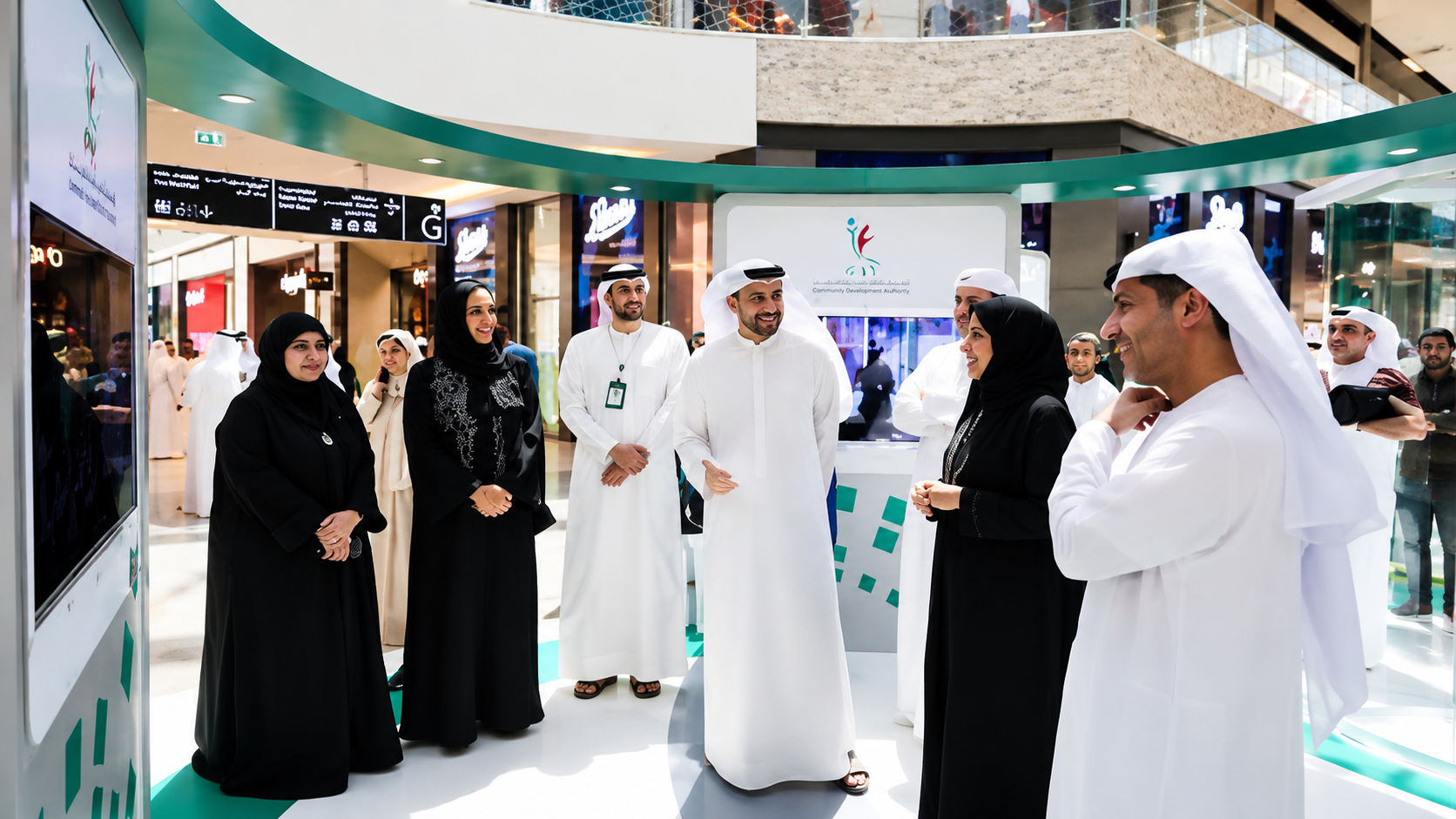
Her Excellency Hessa bint Essa Buhumaid, Director General of the Community Development Authority in Dubai, visited the anti-drug awareness exhibition organised by the General Command of Dubai Police at Dubai Hills Mall, under the slogan “United as One to Eradicate the Threat”.
In the presence of Brigadier Khalid bin Mowaiza, Director of the General Department of Anti-Narcotics, and Brigadier Dr. Abdulrahman Sharaf Al Maamari, Director of the International Hemaya Center, along with representatives of the participating partners, Her Excellency was briefed on the awareness and rehabilitation services and programmes provided by the participating entities, namely the National Anti-Narcotics Authority, the Community Development Authority, the Dubai Health Authority, the Al Ameen Service, the Erada Center for Treatment and Rehabilitation in Dubai, the National Rehabilitation Center, Al Amal Hospital, and the International Hemaya Center at the General Department of Anti-Narcotics.
Brigadier Khalid bin Mowaiza affirmed Dubai Police's keenness to take part in all international events and activities, such as the International Day Against Drug Abuse, given the important role of this day in protecting society from the scourge of drugs and psychotropic substances and in spreading awareness and guidance, and he expressed his thanks to all the work teams participating in the events.
For his part, Brigadier Dr. Abdulrahman Sharaf Al Maamari said that the International Day Against Drug Abuse is an awareness and social occasion on which Dubai Police officers specialised in raising awareness of the harms of drugs meet with members of the public over three days, exchanging suggestions and ideas, gauging the reality and concerns of young people, listening to parents, and devising plans and proposals to build a safe, stable family fortified against the attacks of the weak-willed, through events, lectures and awareness workshops.
Brigadier Abdulrahman Al Maamari praised the active role of the partners of the General Department of Anti-Narcotics, who have contributed and continue to contribute to supporting awareness and rehabilitation work for addiction patients, paving the way for their return to life as upright individuals.
In a related context, officials and specialists from a number of health, social and regulatory entities affirmed that confronting drugs is not limited to the security aspect, but rests on an integrated national system that begins with prevention and awareness and extends to treatment, rehabilitation, aftercare and community reintegration, in a way that enhances the protection of society, supports those in recovery and reduces the chances of relapse.
This came during a press conference held by Dubai Police, coinciding with the International Day Against Drug Abuse, under the slogan “United as One to Eradicate the Threat”, with the participation of representatives of treatment and rehabilitation centres and health, social and customs entities, who reviewed the most prominent programmes and initiatives implemented by the State to confront addiction and psychotropic substances.
Dr. Hassan Al Hammadi, of the National Rehabilitation Center in Abu Dhabi, said that combating addiction requires the cooperation of all entities in order to eradicate this scourge, explaining that the Center provides prevention, treatment and rehabilitation services for addiction patients and those affected by psychotropic substances, and receives citizens at the national level, in addition to residents for a nominal fee.
He pointed out that the Center provides outpatient clinics and inpatient residential services for cases that require specialised therapeutic care, noting that efforts over the past two years have focused more on preventive programmes in schools, universities, exhibitions, festivals, councils (majlis) and residential neighbourhoods, on the basis that prevention represents the first step before treatment, rehabilitation and community reintegration.
For his part, Dr. Abdullah Al Ansari, of the Erada Center for Treatment and Rehabilitation in Dubai, said that the Center participates through two platforms at Mirdif City Centre, to present its services to the public and acquaint them with the means of communicating with it, in addition to highlighting its capacity of 58 beds, comprising 14 beds for detoxification, 32 beds for males, 6 for females, and 6 for adolescents.


He explained that the Erada Center launched an initiative to mentor psychology students at universities, whether after the secondary stage or during university study, with the aim of qualifying cadres specialised in the field of psychology related to substance use and addiction, with a focus on attracting male students.
Al Ansari revealed work on a study to establish a specialised centre for long-term residential addiction treatment, in cooperation with the Community Development Authority in Dubai, with the aim of providing empowering and rehabilitative programmes for those in recovery after completing treatment.
Dr. Ammar Humaid Al Banna, Director of Al Amal Hospital for Mental Health, affiliated with Emirates Health Services, affirmed that confronting addiction requires an integrated system of health, social and security entities, pointing out that the hospital provides specialised services for addiction patients, including detoxification, rehabilitation and community reintegration, in cooperation with a British institution experienced in the field of mental health.
He noted that a number of patients were able, after receiving treatment, to overcome the physical and psychological effects of addiction and return to work, launch their own activities, or reintegrate with their families, which is the main goal of any treatment programme: for the person in recovery to become an active member of society.
Owais Ahmed Al Madani, of Dubai Customs at Dubai Airports, affirmed that Customs represents the first line of defence to protect society from attempts to bring in narcotic substances, pointing to the use of modern technologies, intelligence information and joint cooperation with police entities inside and outside the State, to prevent the entry of drugs via travellers or air, land or sea freight.
He said that Dubai Customs oversees more than 20 customs centres in the emirate, and deals with a large volume of trade and shipment movement, which makes its role pivotal in monitoring and preventing the smuggling of narcotic substances.
He added that Customs employees are qualified and trained to deal with changing smuggling methods, which include concealing drugs inside foodstuffs or fish or inside the human body, affirming that smugglers constantly devise new methods, but Customs develops its capabilities and technologies to detect and counter these attempts.
During the first five months of 2026, Dubai Customs succeeded in foiling attempts to smuggle huge quantities of narcotic and psychotropic substances before they reached society, by carrying out 502 qualitative seizures that resulted in the confiscation of 406 kilograms of narcotic substances and 2,319,989 narcotic pills.


Dr. Halima Al Balooshi, Director of the Awnak Center affiliated with the Community Development Authority in Dubai, said that the Center focuses on aftercare and community reintegration, and its role begins after the person in recovery has finished treatment at specialised entities, such as the Erada Center for Treatment and Rehabilitation in Dubai, Al Amal Hospital or the National Rehabilitation Center, affirming that the post-treatment stage is one of the most important stages of recovery, because it is linked to empowerment and preventing relapse.
She explained that the Awnak Center provides psychological, social and family support for those in recovery and their families, and offers family consultations that help parents understand the nature of the disease of addiction and the mechanisms for dealing with their children.
For her part, Dr. Hind Al Awadhi, of the Dubai Health Authority, said that the Authority's role is concentrated in the pre-addiction stage, through prevention, awareness and promoting a culture of knowledge, affirming that society's understanding of the reality of addiction and the means that may lead to it represents an essential part of protection.