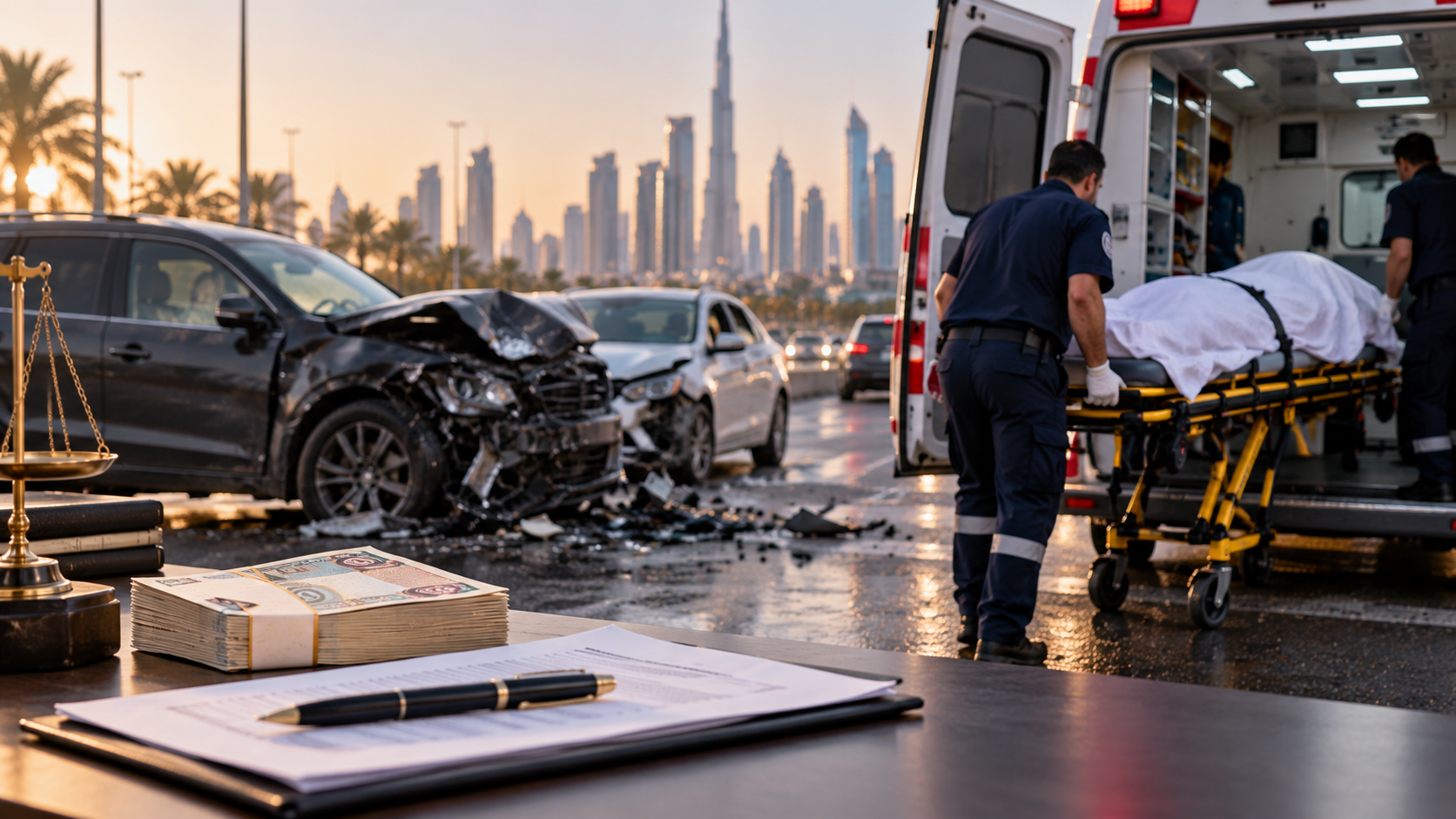
If a criminal judgment awarded you a sum for injuries sustained in a traffic accident — whether diya for the loss of a bodily faculty, a proportion of it for a permanent disability, or arsh for a wound — and you feel the amount does not match what you suffered, the direct answer is this: compensation for a traffic accident does not end with the diya. Entitlement to diya does not prevent you from completing your compensation for the other losses it does not cover, including the loss you sustained and the gain you were deprived of, as well as moral damage outside the cases of diya and assessed arsh. This is not theory; it is the settled position of the Court of Cassation. What matters is knowing that a claim for supplementary compensation for a traffic accident is a civil action independent of the criminal judgment, with its own conditions and its own correct timing.

Diya and arsh: correcting a common misconception
Many believe diya arises only in cases of death. That is inaccurate, and correcting it is the key to understanding your right:
Diya for loss of life
Payable upon death, in a sum fixed in advance.
Diya for the loss of a bodily faculty
Payable to a living injured person where a faculty of the body is wholly destroyed, such as sight, hearing or speech. Where the loss is partial, a proportion of the diya is due corresponding to the percentage of permanent disability.
Arsh
The assessed award for wounds and injuries falling below that; where no assessment is prescribed, the judge fixes it with the assistance of experts.
A living injured person may therefore be awarded proportions of the diya for each faculty affected, which explains the several figures appearing in a single criminal judgment. Yet all of these sums, whatever their label, do not close the door to compensation for a traffic accident in respect of the remaining damage.
What is the difference between diya and compensation?
Confusing the two is what costs people their rights more than anything else. Diya and arsh are awards fixed in advance under Sharia for life and for injuries below it; the criminal judge awards them once the injury and the percentage of permanent disability are established. Civil compensation rests on an entirely different basis: making good the damage actually suffered, in all its elements.
The rule to remember
Entitlement to diya does not prevent the person entitled to it from completing compensation for the other losses that the diya does not cover, including the loss sustained and the gain forgone. Compensation for moral damage is likewise permissible outside the cases of diya or assessed arsh, and falls within the discretion of the trial court.
In practical terms: the diya covers the bodily injury and what accompanied it. Loss of employment, treatment costs, the loss of the chance of a normal life, and chronic pain arising after the injury are other heads of damage that follow an independent path.
A judgment that makes the picture clear
In a case before the Court of Cassation in Abu Dhabi, a woman was injured in a traffic accident. The criminal court convicted the party at fault and ordered him to pay seventy thousand dirhams for injuries to her jaws, nose and limbs. It awarded nothing for her heart injury, because fixing the percentage of disability required surgery and the stabilisation of her medical condition.
After the surgery and once her condition stabilised, a permanent disability of sixty per cent of the function of the cardiovascular system was established. She brought a civil action for supplementary compensation, which the court characterised accordingly and awarded as follows:
AED 61,000
For the permanent disability affecting the function of the cardiovascular system, which the criminal judgment had not covered.
AED 40,000
For being deprived of living a normal life as her peers do, and for the reduction in her chances of obtaining work compatible with her state of health, treated as material damage.
AED 20,000
For the moral damage arising after the injury from chronic pain, fatigue and the loss of the enjoyment of life, which the diya does not cover.
Claim for loss of earnings refused
Because the forensic report established that she remained capable of office work.
The Court of Cassation upheld this and refused the insurer's appeal. The lesson is twofold: the door to supplementary compensation is genuinely open, but it is not opened by general claims — only by defined heads of damage supported by technical evidence.
Which damages can you claim?
Material damage
The costs of treatment, surgery, medication and transport; loss of earnings where your incapacity for work is established; the reduction of your chances of work and promotion; the loss of the chance to live a normal life; and the expenses the family incurred because of the accident.
Moral damage
Continuing physical pain, grief and distress, disfigurement and its psychological and social effect, and the impact of the injury on family life. These are not compensated in themselves where they accompany the injury and fall within the diya; what is compensated is what arose after it and stands independently of it.
One fine distinction costs many claimants dearly: loss of earnings falls away once it is established that you are capable of alternative work, whereas loss of a chance survives, because it rests on a serious prospect that was taken from you. Both should therefore be pleaded, not one.
When do you file? Timing is everything
The commonest error we see is haste. If you file your compensation claim before your medical condition stabilises, the damage is assessed on an incomplete basis, and returning to the same heads afterwards becomes difficult.
The practical rule: wait for your condition to stabilise and for a final medical report fixing the percentage of disability, then claim. Whatever the criminal judgment did not cover because the condition had not stabilised remains open to a later claim — which is precisely what happened in the case above.
30
days
The usual period for appealing judgments in many situations, which is why the criminal judgment must be examined as soon as it is issued to identify what it decided and what it left open.
3
years
The usual limitation period for an action in tort, running from the day the injured party knew of the damage and of the person responsible for it; a file should therefore not be left open without action.
15
years
The outer limit after which the action is barred in all events, running from the day the harmful act occurred — a ceiling that is of little practical use.
Whom do you sue?
The party at fault and the insurer together. The unified motor insurance policy obliges the insurer to cover third-party liability, and joining the company from the outset spares you an entire enforcement stage. Suing the driver alone is a mistake, because enforcing against an individual can be far harder than enforcing against a company.
If the party at fault or his assets are outside the country, see Filing a Lawsuit Against a Person Outside the UAE and Enforcement of Foreign Judgments in the UAE. If you operate a garage with receivables from an insurer, the route is different and is set out in Collecting Garage Dues from Insurance Companies.
Practical steps
DOCUMENTATION
Assemble the complete file
The police report, the criminal judgment, the medical and forensic reports, treatment invoices, and the end-of-service certificate or whatever establishes the accident's effect on your work and income.
CHARACTERISATION
Identify what the criminal judgment left out
Read the criminal judgment closely and identify the injuries it decided upon and those it deferred or omitted. That space is the subject of your action.
CLAIM
Submit the claim to the insurer
Many files settle amicably where the claim is presented with ordered documents and a realistic valuation, which is faster and cheaper than litigation.
LITIGATION
File the civil action with defined heads
Do not claim a single global figure; itemise each head of damage with its supporting evidence, and request the appointment of an expert or the forensic authority to assess what has not yet been assessed.
ENFORCEMENT
Follow through to actual payment
Advice that protects your right
Do not sign a hasty release
Signing a general discharge in exchange for a quick payment may close the door permanently, even as to damage that has not yet appeared.
Document the accident's effect on your income
An end-of-service certificate or a letter from your employer linking the accident to the loss of your job is among the strongest support for a claim of material damage.
Do not overlook moral damage
Many claims are confined to invoices, while moral damage is an independent head that the courts have in fact awarded.
Keep everything that evidences your claim
The criminal side of the accident
If you are the party at fault rather than the injured party, the path is entirely different and you face criminal proceedings alongside the civil claim. We have covered this in Accused of a Crime in the UAE, Referral to the Public Prosecution and Detention and Alternatives to Imprisonment in Misdemeanor Cases. Selling the vehicle or transferring its ownership after an accident also has its own rules, set out in Vehicle Ownership Transfer in the UAE.
Legal References
Federal Decree-Law No. 25 of 2025 Issuing the Civil Transactions Law
Federal Decree-Law No. 42 of 2022 Issuing the Civil Procedure Law
Insurance Authority Board Decision No. 25 of 2016 Issuing the Unified Motor Vehicle Insurance Policy
Federal Law No. 6 of 2007 Concerning the Regulation of Insurance Operations
Federal Decree-Law of 2025 Concerning the Central Bank and the Organisation of Financial Institutions and Activities
Judgment of the Court of Cassation of Abu Dhabi in Appeal No. 263 of 2019 Civil, session of 12 January 2020
Do you believe the diya did not do you justice?
The team at AWADH ALMHEIRI LAW FIRM AND LEGAL CONSULTATIONS examines the criminal judgment and the medical reports, identifies the damage for which you were not compensated, and values it realistically before the action is filed.
Specialised legal advice in compensation and accident cases
Frequently Asked Questions
QI received diya under a criminal judgment. Can I still bring a compensation claim?
Yes. The Court of Cassation has settled that entitlement to diya does not prevent the completion of compensation for the other losses the diya does not cover. It is a civil action independent of the criminal judgment.
QWhich damages does the diya not cover?
The loss you sustained and the gain you were deprived of, the loss of the chance of a normal life and of work opportunities, and the moral damage that arose after the injury and stands independently of it. Moral damage accompanying the injury itself falls within the diya.
QWhen do I file — immediately or after treatment?
After your condition stabilises and a final medical report fixes the percentage of disability. Haste leads to an undervalued award of compensation for a traffic accident that is hard to correct later.
QDo I sue the driver or the insurer?
Both. Insurance covers third-party civil liability, and joining the company from the outset makes enforcement straightforward.
QHow much is the compensation?
There is no fixed schedule. Assessing the compensation that makes good the damage lies within the discretion of the trial court once it has set out the elements of the damage, and the law binds it to no particular criteria. Presenting and supporting the heads of damage well is what makes the difference to the figure.
QThe court refused my claim for loss of earnings. Is that the end?
Not necessarily. Loss of earnings is refused where your capacity for alternative work is established, but the reduction of work opportunities and the loss of a chance is an independent head that may still be awarded.
QDoes the compensation extend to those who were with me in the vehicle?
Yes. Every person harmed by the accident has an independent right to claim, and the damage is assessed separately according to the injury and the circumstances.
QI signed a settlement with the insurer. Can I still claim more?
It depends on the wording and scope of the release and on whether it covered damage that had not yet appeared when it was signed. Show the release to a lawyer before assuming the door is closed.
QDo I need a lawyer?
A compensation claim is won on characterisation and itemisation, not on the size of the sum claimed. Engaging
a legal consultant lawyer in Dubai from the moment the criminal judgment is reviewed spares you the omission of heads of damage that cannot be revisited.

Legal Disclaimer
This content is provided for legal awareness and community education. It does not constitute legal advice or an opinion on any particular matter. Outcomes differ according to the facts of each accident, its documents and its medical reports, and you are advised to consult a specialised lawyer before taking any step. The Arabic text of this article is the authoritative reference in case of any discrepancy between it and this translation.
Dubai
AWADH ALMHEIRI LAW FIRM AND LEGAL CONSULTATIONS handles compensation claims for traffic accidents in Dubai, including supplementary compensation after a criminal judgment, proceedings against insurers, claims for material and moral damage, the assessment of disability and challenges to expert reports. If you are looking for a
law firm in Dubai specialised in accident and compensation cases, we handle the file from the review of the criminal judgment through to enforcement. Medical malpractice connected with treatment after an accident follows its own path, set out in
Medical Malpractice Lawyer in the UAE.
The Other Emirates
We handle compensation claims for traffic accidents in Abu Dhabi, Sharjah, Ajman, Umm Al Quwain, Ras Al Khaimah and Fujairah, before both civil and criminal courts, taking account of the differing procedures and forensic authorities in each emirate.

 العربية
 Русский
 اردو
اردو
 中文
中文
 Français